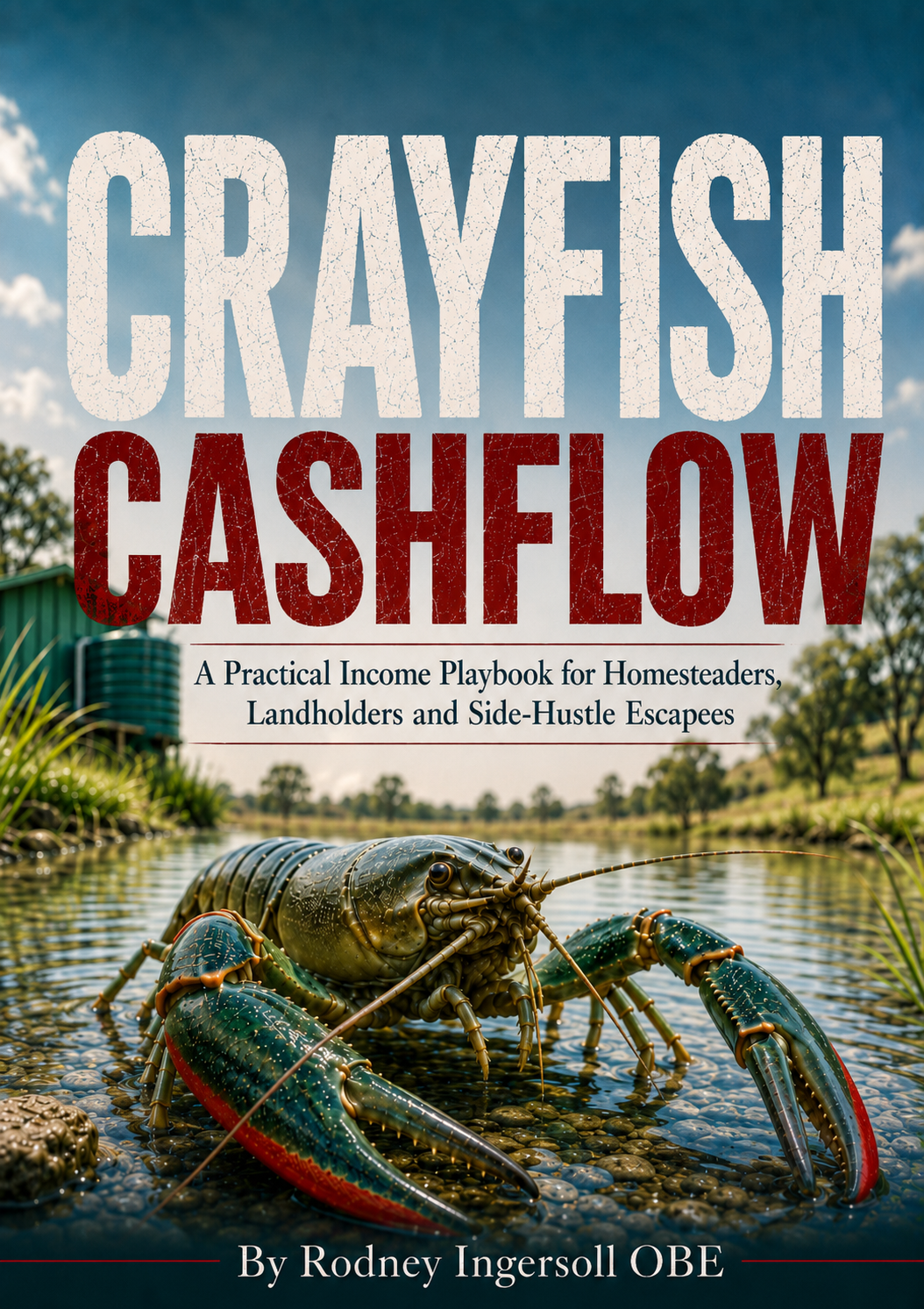
Crayfish Cashflow
— A new book by Rodney Ingersoll OBE —

The most overlooked
real-world income opportunity
most people scroll right past

A working farmer with 30 years across two countries and an OBE for practical impact reveals what survived a cyclone, a flood, and more than $1.5 million in losses — and why it might be the most sensible food-based income opportunity most people have never seriously considered.

Yes! Rush me a copy — $20
Ebook only · Instant download

The real problem isn't your motivation

You already know online side hustles are crowded. You've felt it. You've bought the course, joined the group, started the thing, and somewhere around week three you realised you were one of ten thousand people doing the exact same thing on the exact same platform, all trying to get the algorithm to notice you.

So you stopped. Or you kept going and nothing changed, which is its own kind of exhausting.

Nobody says this out loud: the problem isn't your effort. You have plenty of that. The problem is the category you've been working in. And the category is broken in a way that no better funnel, no better hook, no better content strategy will fix.

There is a different kind of income opportunity. Physical. Food-based. Unusual enough to stop people mid-sentence. And largely unknown outside of a very small group of farmers in Australia and scattered operators across Asia and the Pacific.

Most people have never heard of Australian Redclaw Crayfish. That's exactly the point.

The Shocking Truth About Why You're Still Stuck

The common belief goes like this: if you're not building income online, you're behind. Funnels, content, digital products, affiliate marketing, something involving your phone. You've heard it so many times it doesn't even sound like advice anymore. It sounds like gravity.

The problem is that most people saying it have never made serious money from it, and the ones who have are usually selling you the course about how they did it.

The real story: a hundred million people are competing for the same finite pool of online attention. The platforms take a cut of every conversation. The algorithms change the month after you learn them. And unless you already have an audience or a product people genuinely want, you are spending your energy on infrastructure that benefits everyone except you.

Meanwhile, the actual physical world still needs food. Still wants premium, unusual, story-worthy food. Still has almost nobody producing it at the scale buyers are asking for.

The opportunity isn't in getting better at the internet. It's in stepping off that particular treadmill entirely and looking at what's already sitting in your backyard, your shed, your dam, your unused tank.

Why Traditional Approaches Keep You Trapped

Online income models are built for people who are already comfortable on camera, already have audiences, already enjoy writing daily content, already have the patience to wait eighteen months for an algorithm to reward them. If that's you, great. This isn't your book.

For everyone else, there's a quieter trap at work. Every course you buy without finishing takes a small deposit out of your ability to trust your own word. Every plan you outline and quietly abandon takes another. The treadmill doesn't just waste your time. It slowly erodes the version of you who made a decision and followed through.

Physical opportunities don't work that way. A pond either has water in it or it doesn't. An animal either grew or it didn't. A chef either rang back or he didn't. The feedback is real, and it arrives in weeks, not algorithmic years.

That's the structural difference. Not the glamour of it. The feedback loop.

See, I Was Just Like You

In the years before the flood, I was running too many things at once. Shares. Currency trading. Affiliate marketing. Online courses. A website or two that never quite got finished. Each one had potential on paper. Stacked together, with a wife, three young children, a demanding career, and later a farm to manage, they became a mess. I was trying to build security for my family, but I built complexity instead. Every new course, every new offer, every new strategy pulled me toward the next thing before I'd finished the last. I was drowning in possibility and starving for focus.

Then on 17 December 2023, Cyclone Jasper sat over my farm in Far North Queensland and wouldn't leave.

The rain kept coming. The Barron River rose. By the time the water peaked, the house and sheds had twenty centimetres of stinking mud through every room. Bore motors, blowers, paddle wheels, oxygen gear, pipes, tanks, breeding infrastructure — mostly ruined. There was a crocodile in one of the ponds. No electricity for weeks. No car for six months. I slept in a tent while I cleaned up my own home.

And the Barramundi swam away.

That sentence sounds simple. It represents more than $1.5 million of borrowed money, years of hard work, and the collapse of an entire business model. The bank did not care that the fish were gone.

But something else happened in those same ponds. The Australian Redclaw Crayfish — which I only had in four ponds at the time — mostly stayed. They sat at the bottom and waited it out. They didn't need the expensive oxygen input the Barramundi needed. They didn't need me at my strongest.

That's when the farm started teaching me a different lesson. The real business wasn't the fish I'd been chasing. The real business was the thing I'd been half-ignoring. I'd spent years looking for opportunity on a screen while something genuinely unusual was sitting in a pond ten metres from where I slept.

That question — what actually survived, and why — is what this book is about.

The real business wasn't the fish I'd been chasing. The real business was the thing I'd been half-ignoring.

The Redclaw Revolution

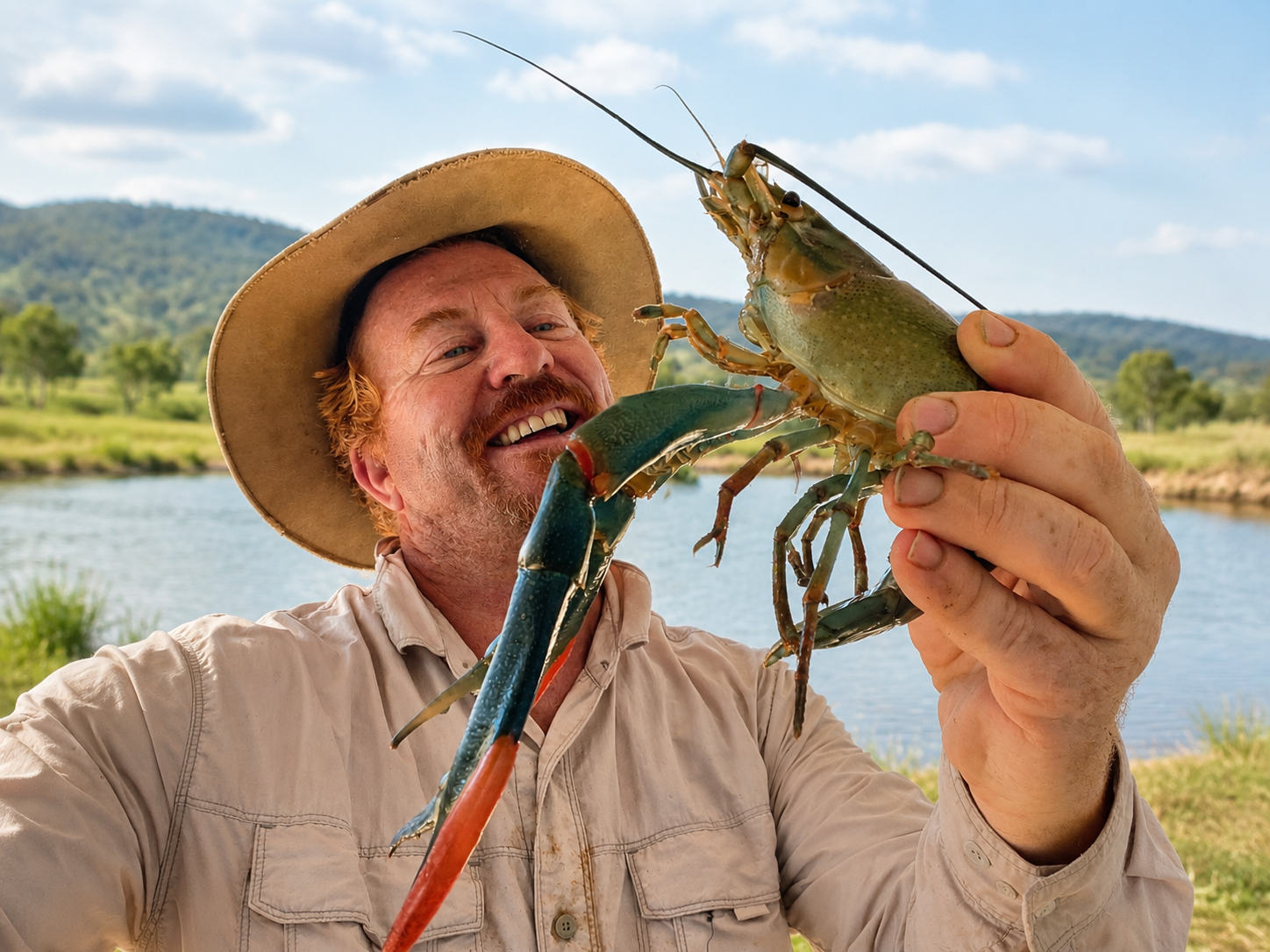
Australian Redclaw Crayfish aren't a farming novelty. They're a premium, unusual, story-worthy food product that creates curiosity before it creates a dollar.

Attention isn't a soft asset. The first product isn't the crayfish. The first product is the attention the animal earns the moment someone sees one for the first time.

When someone picks one up, they ask four questions in a row without stopping. What is it? Can you eat it? Where does it come from? How big do they get? That curiosity is built into the animal. A carrot doesn't do that. A chicken doesn't do that. A punnet of blueberries doesn't do that.

That attention becomes trust. Trust becomes buyers. Buyers become an income stack. The Redclaw sits at the centre of it, but it's not the whole business. The crayfish is the doorway. The business is the room behind the door.

The ARC Income System

A practical framework for seeing and assessing this opportunity before you spend serious money you can't afford to lose — three phases, seven steps, and an order that matters more than any individual piece.

01
Step 1: See the Opportunity
Stop seeing Redclaw as just aquaculture. Start seeing it as a premium, unusual, food-based business with income pathways most people have never considered.
02
Step 2: Audit What You Already Have
Look at what's actually on your side of the table before you spend a dollar. Backyard, shed, dam, tanks, land, water, family, location, local networks. Most people are closer to a starting point than they think.
03
Step 3: Check the Rules
What's legal in your jurisdiction, for your species, on your land, at your scale, matters enormously and varies more than any internet search will tell you. This step keeps the opportunity grounded and you out of trouble.
04
Step 4: Test Before You Spend
Talk to potential buyers. Price the market. Understand what people will actually pay before you build anything. This stops you building first and hoping buyers appear later.
05
Step 5: Build the Right System
Start at a scale where your mistakes are survivable and educational. Tank, IBC, one or two ponds — whatever fits your land, your budget, and the version of life you're actually living.
06
Step 6: Stack the Pathways
Build more than one income stream around the same animal. Live Redclaw, jumbo for restaurants, breeding stock, farm-gate, workshops, tours, aquaponics, local food branding, content, consulting. The Redclaw is the root system. The pathways are branches.
07
Step 7: Scale With Discipline
Expand only after costs, systems, and buyers are proven. The prepared grower scales from evidence. The excited one scales from hope, and then spends five years trying to unwind decisions made in month one.
Claim your copy and see whether this fits your situation — $20
Instant download

What Others Are Saying

"I had two Redclaw in a fish tank on my sideboard. Thought it was just a hobby. Eighteen months later I've got a working aquaponics setup, a small pond, and about two hundred dollars a week coming in. More importantly I'm building something. That changed everything for me."

— Daniel

"I was sitting on good land and doing nothing with it. This book helped me see what I was looking at. Not fish tanks. An actual opportunity stack."

— Leanne

"I've done three online side hustles in four years. None of them worked. This was the first time someone told me the honest version of what it takes, and the honest version of what's possible."

— Minh

"I came into the strategy call with a dam, no budget to speak of, and real scepticism. Rodney spent the first ten minutes checking whether this was even the right fit for my block. It wasn't, in the shape I'd been imagining. But the conversation shifted what I was looking for. I came back six months later with a different setup, a different plan, and the beginnings of a real starter system. The honest 'not yet' on the first call saved me from a very expensive mistake."

— Small landholder, coastal Queensland

"I kept waiting for the pitch. It never came. Just a farmer being straight about what works, what doesn't, and why most people fail before they start."

— Reader

"The chapter on the four traps is worth the price of the book on its own. I could see myself in all four. That was uncomfortable. It was also the most useful thing I've read in two years."

— Reader

"I've been in aquaculture for years. Still found things in here I hadn't thought through properly, especially the income stacking section. Recommended it to two people already."

— Small farm operator

What You'll Discover Inside

01
The Pond That Stayed
What actually happened on Rodney's farm during Cyclone Jasper, why the Barramundi swam away, and what the Redclaw's survival revealed about which opportunities are real and which ones just look real from a distance.
02
The Online Side-Hustle Treadmill
The four specific traps that keep smart, motivated people running hard and going nowhere — and why the fix isn't a better course, a better tool, or more discipline.
03
The Income Pathway Map
Fourteen distinct ways Redclaw can generate value off a single piece of land, most of which the average beginner has never considered.
04
The Three Real-Life Shifts
Three people — a backyard grower, a lifestyle-block producer, and a family that built something together — and what actually changed for them in their bank accounts, their confidence, and their daily life.
05
The ARC Income System
The complete seven-step framework for assessing, building, and monetising a Redclaw operation in the right order, with worked examples at each stage and a clear explanation of why the sequence matters more than the individual steps.
06
Water Is the Farm
What every beginner gets wrong about the biological asset at the centre of this business, and why the people who skip oxygen, habitat, biosecurity, and records always find out the hard way.
07
The Gate Before the Farm
The four non-negotiables that have to be true before the framework works at all, the three most common ways people wreck the opportunity before it starts, and one honest account of a client Rodney couldn't help — and why.
08
The Fourteen Income Pathways, Ranked
How to look at the full list of possible income streams and honestly rank which two or three actually fit your land, your temperament, your skills, and the life your family is living right now.
09
The Research and Development Pathway
A legitimate income support pathway most small farmers have never considered, what it requires to qualify, and why Rodney has had years where his structured R&D work returned more than selling the animals did.
10
The Call Before the Cost
What a book can do and what it can't, why a 30-minute conversation about your specific situation is the next real step, and exactly what to have ready before you get on the call.

Is This Right For You?

This is NOT for those who —
  • Want a passive income where the animals feed themselves and the money arrives automatically.
  • Would rather read about farming than do it, indefinitely.
  • Want agreement on what they've already decided, rather than honest feedback on whether it's likely to work.
  • Are unwilling to check local laws and permits before buying stock — or who will be personally offended when the regulator says no.
This book is for —
  • The person who already has something physical to work with, or is willing to find it. A backyard, a dam, a shed, a spare tank, a bit of land.
  • Someone who is tired of the screen-based income treadmill and wants something that produces a real product they can hold in their hand.
  • Someone willing to become a beginner again, to check the rules, to start smaller than their ego prefers, and to build from evidence rather than excitement.
Claim your copy now — $20
Instant download

Frequently Asked Questions

Isn't this just another aquaculture book?
No, and the book is upfront about that from the first page. This is a business-opportunity book that happens to involve Australian Redclaw Crayfish. It won't replace a technical manual on pond engineering or feed conversion. What it does is help you decide whether the opportunity is worth pursuing in the first place, and how to think about it in the right order — before you spend serious money. The people who need this book are not aquaculture students. They're people who want to understand the opportunity before they commit to the infrastructure.
Do I need land or prior farming experience?
No, and the book works through this carefully. Some people start with a tank on a kitchen bench. Others have a dam they've never done anything with. The question isn't how much land you have. It's what you plan to do with what you already have before you go looking for more. Teachability matters more than technical background.
How quickly could I see results?
The book makes no income promises and no timeline guarantees. What it does promise is this: by the time you finish reading, you'll know whether Redclaw is worth another thirty days of your attention. Not riches. Not freedom by Christmas. Clarity, a wider view of the income pathways, and one wise next step.
Is Redclaw legal where I live?
Possibly, possibly not. The book is clear that legal status varies significantly between jurisdictions, species definitions, and local council overlays. One of the first steps the ARC Income System asks you to take is to check your legal envelope before you buy stock, build anything, or spend a dollar. The book tells you exactly how to approach that conversation.
What if my family thinks this is a bad idea?
The book has a chapter on what Rodney calls the family barbecue advisory board. The people who will give you the loudest opinions on this are usually the people with the least exposure to it. Emotional support from family is worth protecting. Technical judgment you take from people who have actually built the thing. The book helps you tell the difference.
What happens after I read the book?
At the back of the book, Rodney offers a free strategy call for readers who want to look at their specific situation. It's a fit conversation, not a sales pitch. Sometimes he tells people to go ahead. Sometimes he tells them this isn't right for them, or not yet. Either answer is worth having before you spend anything else.
Rodney Ingersoll OBE

Rodney Ingersoll OBE.

Rodney Ingersoll OBE is an environmental scientist, educator, farmer, and consultant who has spent more than thirty years working at the intersection of practical food production, environmental management, and community development. He struggled at university. The letters after his name now mislead people into thinking it came easily. It didn't. What he learned early was that his future would be built on discipline, faith, and showing up when he felt out of his depth.

For more than twenty-two years, much of his work took place in Papua New Guinea, in remote village communities and volatile tribal environments, where he helped deliver practical skills in food production, environmental conservation, health, sanitation, and community resilience. He has managed a wildlife sanctuary, authored scientific papers, led large teams, and delivered programs where people's lives were directly attached to the outcome. For that work, he received the Order of the British Empire medal of Honour from Her Majesty Queen Elizabeth II, along with recognition from the Papua New Guinea Government for distinguished service.

He runs Barron River Redclaw in Far North Queensland, a working aquaculture farm focused on Australian Redclaw Crayfish, sustainable food production, aquaponics, education, and regional food resilience. He also serves as Vice President of the North Queensland Redclaw Farmers Association. The flood that cost his farm the Barramundi business is described in the book's introduction. What it cost him financially is also there, in plain language. He doesn't dress it up. What he does is describe what survived and what the survival of the Redclaw forced him to see about opportunity, resilience, and the assets most people ignore while they're staring at a screen. He is not writing as someone untouched by mistakes. He knows what it feels like to build complexity when you were trying to build security. And he knows what it feels like to look at the one thing that survived and realise the next step is not another new idea.

One last thing

The person standing at their water twelve months from now, knowing their numbers, knowing their animal
with one customer they didn't have this year and a plan for a second one
made a quiet decision somewhere around now

They got off the treadmill. They looked at what was already in front of them. They started at a scale that made sense. That version of your life starts with understanding the opportunity clearly. This book does that job.

Yes! Rush me a copy — $20
30-day refund · Ebook only · Instant download